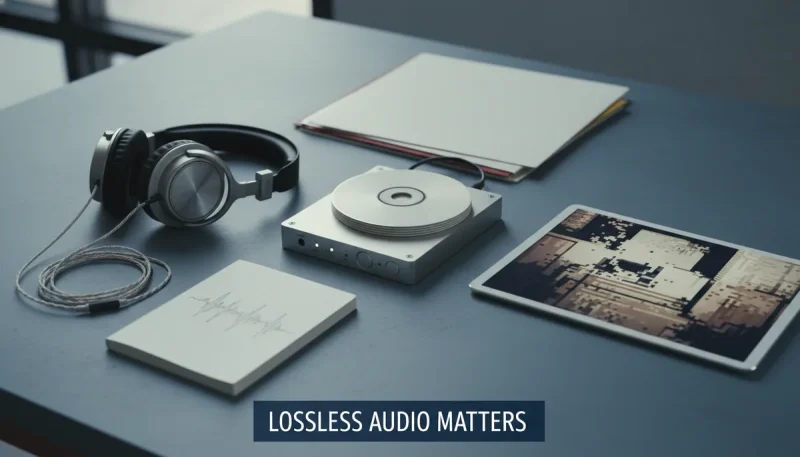


Why Lossless Music and High-Fidelity Downloads Matter
Lossless music unlocks the full detail and dynamic range artists intended, giving listeners and creators the ability to hear, preserve, and work from a faithful representation of the original recording. This guide explains what lossless means, when it matters, and how to make practical choices as a listener or maker. ⏱️ 5-min read
What lossless means and common formats
“Lossless” means the audio file contains the same digital information as the original master — no musical data is discarded. Common lossless formats are FLAC, ALAC, and WAV. FLAC and ALAC are compressed without losing information, so files are smaller than WAV but still identical when decoded; WAV (and AIFF) are uncompressed PCM containers that store raw samples.
Lossy formats like MP3 or AAC reduce file size by permanently removing audio deemed less important to human perception. That can be perfectly acceptable for background listening or low-bandwidth streaming, but when accuracy matters — critical listening, mastering, or archiving — lossless preserves everything the artist and engineer created.
Listening benefits: what lossless adds for listeners
Lossless audio can reveal cleaner transients, more natural-sounding reverb tails, tighter imaging, and a truer sense of space. Those improvements come from preserved micro-details and wider dynamic range, not from some mystical quality inherent to the file type.
How noticeable the benefits are depends on the recording and playback chain. Examples:
- Classical and acoustic jazz: greater dynamic nuance and decay make phrasing and room acoustics more realistic.
- Ambient and electronica: more detailed textures and lower noise floors, which deepen immersive mixes.
- Rock and pop: benefits show up in punch and clarity if the mastering left headroom; heavily compressed masters may show smaller gains.
In short, lossless matters most when the source material contains subtle details and dynamic contrasts, and you’re using equipment capable of resolving them.
Creators’ perspective: mastering, archiving, and distribution
For creators, lossless files are a practical necessity. Masters kept in lossless form allow accurate monitoring, reliable loudness and EQ decisions, and future remasters without cumulative generational loss. Storing stems and masters in lossless formats preserves the original sonic intent.
Good archival and distribution practices include embedding accurate metadata (ISRC, composer/performer credits, version notes) and keeping clear records of rights and licensing. When you deliver to streaming services or distributors, provide the highest practical-quality master and a DDP or lossless file set for manufacturing or future use.
Formats, bit depth, and sample rate: metrics that matter
PCM is described by bit depth and sample rate. Typical consumer and professional standards are:
- 16-bit / 44.1 kHz — CD quality. Plenty of dynamic range for most listening situations.
- 24-bit / 96 kHz — common “hi-res” choice; more headroom and finer quantization, useful in production and for some playback systems.
- 24-bit / 192 kHz — higher sample rate; benefits are situational and often debated.
“Hi‑res” generally means formats or files above CD specs (greater than 16/44.1). Higher bit depth reliably increases usable dynamic range and lowers rounding noise in processing; higher sample rates can help certain production workflows but do not automatically produce audible benefits on playback. Evaluate by testing: listen critically, match loudness, and compare in blind tests rather than assuming higher numbers always sound better.
Platforms and delivery: where lossless lives
Legitimate sources for lossless and high‑resolution downloads and streaming include Bandcamp (lossless downloads), Qobuz and HDtracks (hi‑res downloads), and streaming tiers from services like Tidal HiFi, Qobuz, Amazon Music HD, and Apple Music (ALAC). Bandcamp is especially artist-friendly for direct sales and high-quality downloads; HDtracks and Qobuz specialize in high-res releases.
Consider these trade-offs:
- Downloads: full file ownership, best for archiving, can be delivered in FLAC or ALAC.
- Streaming: convenient and increasingly high-quality, but dependent on subscription tier and network; some platforms transcode for offline play.
Expect file types such as FLAC, ALAC, WAV, and in some catalogs DSD. Check the store or service for exact specs before purchase.
Hardware and listening setup: maximize your gains
To hear the advantages of lossless, the playback chain must be competent. Key considerations:
- DAC: a clean digital-to-analog converter reduces jitter and preserves detail.
- Amplification and transducers: quality headphones or monitors and an appropriate amp bring out dynamics and imaging.
- Room and placement: for speakers, room treatments and placement are often the biggest factor in perceived sound quality.
- Storage and backup: keep masters and purchased lossless files on redundant storage; use checksums or FLAC’s built-in verification for integrity.
You don’t need the most expensive gear to benefit — sensible upgrades and proper setup will yield the best return on investment.
Best practices for legal consumption and distribution
Listeners should obtain lossless files through legitimate stores or subscription services. Steps for listeners:
- Choose reputable platforms (Bandcamp, Qobuz, labels’ webstores).
- Prefer lossless download options and keep original files backed up.
- Verify file integrity when possible (checksums or player confirmations).
For creators distributing lossless music:
- Deliver masters in lossless formats and include full metadata and ISRCs.
- Use a reputable distributor or direct sale platform, and retain masters for future remastering.
- Handle licensing and rights clearly; provide cue sheets and credit data where required by platforms and broadcasters.
These steps protect the music legally and ensure listeners receive the intended quality.
Myths vs reality and common pitfalls
There are a few persistent myths worth dispelling. First, better gear alone won’t fix a poor recording or over-compressed master — good source material is primary. Second, bigger files don’t guarantee audible improvement; content and mastering quality matter as much as bit depth and sample rate. Third, many casual listeners can’t reliably tell subtle differences in a quick A/B test unless listening conditions are controlled.
Try this simple calibration approach to judge differences fairly:
- Use a trusted reference recording you know well.
- Match playback loudness between files exactly (loudness bias skews perception).
- Conduct blind A/B comparisons, switching without looking and taking short breaks.
- Assess on more than one playback system — headphones and speakers — to confirm impressions.
That method separates real audible differences from expectation or placebo effects and helps you make informed choices about formats and gear.
Powered by Trafficontent



暂无评论内容